Learn English with ChatGPT. Hear it in movies.
Describe what you want to say, understand or practice in ChatGPT. The Playphrase.me skill selects English expressions from Common Phrases, explains them and links to lines spoken in movies and TV shows. Copy any of the prompts below into your own chat.

Playphrase.me is a website for finding short lines from movies and TV shows. Search for an expression and move between scenes where it appears. Beside the video, you can see the line, its translation and the movie or show's title. Hear a familiar phrase in different voices and conversations.
The skill queries the public Common Phrases catalog and selects expressions for your request. Describe an idea in your own words, ask about a nuance or request another option. The answer includes English wording and ready-to-open links; you don't need to know the phrase or build a search first.
Sample conversation: accepting an invitation
Copy this prompt
@PlayPhrase.me How can I say that there's no way I'd miss it? A friend invited me to their wedding.Sample response
Continue this conversation
Why does the phrase use for the world?Sample response
The explanation stays in ChatGPT; the link opens the spoken line. After listening, return to the same conversation: “Can I say it more briefly?”, “What if it's a work event?” or “Explain it again with a different example.”
Keep talking until it makes sense
The first answer is a starting point. Adjust the tone, ask for simpler expressions, compare options or explore a single word. Within the current conversation, the skill takes account of the situation and phrases already discussed.
Sample conversation: declining and suggesting another time
Copy this prompt
@PlayPhrase.me I've been invited to dinner tonight, but I can't go. How can I decline in a friendly way and suggest another day?Sample response
Continue this conversation
Does make it mean “create something” here?Sample response
Continue this conversation
What if a colleague and I are moving a work meeting? How can I say that we'll have to change the date or time?Sample response
The conversation helps with more than a translation. It helps you choose wording that fits your relationship and the way you're communicating: speaking aloud, messaging a friend or writing a work email.
Sample conversation: understanding a line you heard
Copy this prompt
@PlayPhrase.me What does Would you give me a break? mean? Can I say it to my boss?Sample response
Continue this conversation
I've just started a job and want to explain that I'm still adjusting and need a little time. How can I say it more calmly?Sample response
A movie gives you one particular delivery: a voice, a pause, the other person's reaction. One scene won't show every possible use, so open other results too. If a specific scene raised your question, quote the line in ChatGPT and describe what happens.
A simple question in your own words is enough to start. If you know the expressions, say “I know these; suggest something else.” If they're difficult, try “Use simpler wording and explain in simple English.” For a general selection, the skill may ask how challenging the material should be. You don't need to know the A1–C2 level labels.
Find phrases and scenes for your own needs
Choose a prompt and copy it into ChatGPT with the skill installed. Change the situation, level or topic to suit you. ChatGPT selects expressions, explains them and gives you links; the videos open on Playphrase.me.
Prepare for an upcoming conversation

@PlayPhrase.me I have a job interview tomorrow. Help me describe my experience in simple English. I've worked with customers and trained new employees. Add links so I can listen to the key expressions.This gives the answer a concrete task and facts to work with. After the first version, ask for a shorter account, replace a phrase you find awkward or rehearse a question about your previous job.
Order food and check the details

@PlayPhrase.me I'm a beginner. Choose a few expressions for a café: ordering food, asking about ingredients and requesting the bill. Explain in simple English and give me listening links.Write a message to your landlord
@PlayPhrase.me Help me tell my landlord in English that the heating isn't working and arrange a time for repairs. Choose suitable expressions and give me links to hear them.Make your wording more natural

@PlayPhrase.me I wrote: “I very want to see you”. Correct it and choose a natural alternative from Common Phrases. Explain the difference and give me a listening link.Tell similar expressions apart

@PlayPhrase.me Compare I guess, I suppose and I think. Explain the differences and link to each expression on Playphrase.me.The catalog includes I guess you could call it that. and I suppose you could call it that., for example. Both can express qualified agreement with the way someone has described something. For more direct agreement, listen to I think you're right.. Then ask in the chat: “Which option fits when I'm not entirely sure?”
Understand grammar and phrasal verbs
@PlayPhrase.me Explain the difference between I used to and I’m used to. Give short examples and listening links.For example, I used to go there. describes a past habit, while I'm kind of used to it. says something is now fairly familiar. These lines give you two different uses of used to to explore.

@PlayPhrase.me The phrase pick up has several meanings. Explain the difference between Pick up the phone right now! and Let's pick up where we left off.Pick up the phone right now! asks someone to answer the phone immediately, while Let's pick up where we left off. suggests continuing from where you stopped. Both expressions are in Common Phrases.
Narrow your question to the part you don't understand. After the explanation, follow the links to hear the English structures in spoken lines, then return with a question about form or meaning.
Choose material when you don't have a specific question

@PlayPhrase.me Choose a few everyday expressions for meeting new people. My English is at beginner level. Explain in simple English.On the website, Common Phrases is an expression catalog with level and topic choices; Vocabulary helps you work with words. In ChatGPT, describe the topic and difficulty you want. The skill can query Common Phrases through its public API, select catalog expressions and provide an individual link for each. The listening examples on this page use expressions from confirmed catalog entries.
Move on to less familiar expressions

@PlayPhrase.me Give me five useful B2 idioms from Common Phrases. Briefly explain when people use them and provide a separate link for each.Ask for a fresh selection in the same conversation
I already know these expressions. Suggest different ones on the same topic, a little more advanced. Don't repeat the previous ones, and keep the listening links.Hear how people disagree
@PlayPhrase.me Choose expressions for disagreeing calmly in a conversation. Intermediate level. Explain how the options differ and give me Playphrase.me links.Find a line for your own collection

@PlayPhrase.me Find an expression in Common Phrases that means “I told you so”. Explain its nuance and give me a link to search for clips with the phrase.Common Phrases includes I don't want to say I told you so. Despite the opening, the speaker is still reminding someone of an earlier warning. Open a clip search for this phrase on Playphrase.me, browse the results and choose a line you find interesting in its own right. It could go into a personal collection or become an example for a future lesson.
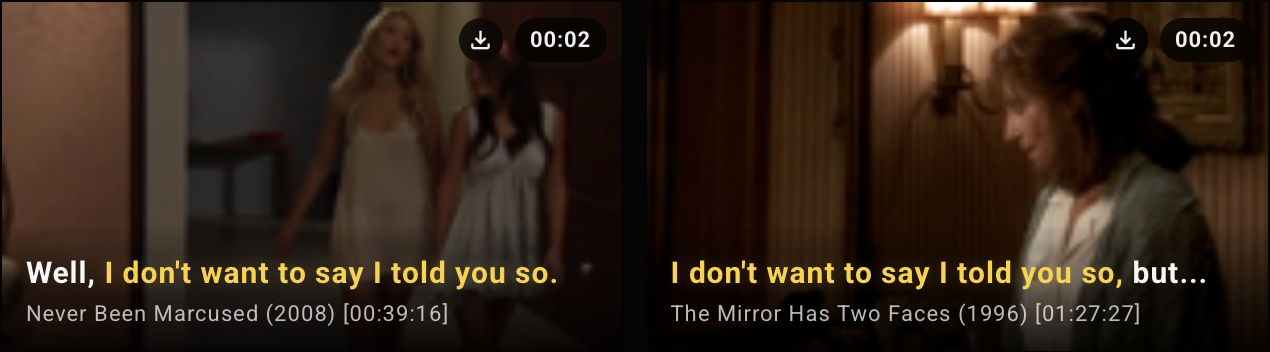
In Clip Search, narrow your search by movie, TV show, year and other available filters. If the speaker and delivery matter, open the result itself: an actor's presence in a movie doesn't identify who says a particular line.
Recover words from memory

@PlayPhrase.me I remember carry at the start and forward at the end, but I've forgotten the middle. Find matching expressions in Common Phrases and give me links. If there's no match, link to a search with missing words.The skill can suggest catalog expressions or a search for carry * forward. The asterisk leaves room for missing words. The answer includes a link with the query already filled in.
Keep listening on the website without ChatGPT: move between results, use the available speed and repeat controls, save expressions in Favorites or watch them in Reels. Return to ChatGPT for your next question about meaning or wording.
Build a short practice session around one situation
When you want practice, ask for it directly in the conversation:

@PlayPhrase.me I have ten minutes. Let's practice declining politely in English. First, go through a few expressions with Playphrase.me links. Then give me one situation at a time, wait for my answer and explain my mistakes. Intermediate level.Start with expressions and explanations. Follow the listening links and spend more time on any phrase that raises questions. To begin the exercise, return to the chat and say: “I'm ready. Give me the first situation.”
Answer in your own words. ChatGPT reviews your response, explains the expression you chose and then offers the next situation. Ask for a hint, adjust the difficulty or pause to explore one mistake.
For teachers, a lesson topic can be the starting point:
@PlayPhrase.me I'm preparing an intermediate lesson on polite requests. Suggest expressions with listening links and questions to help students compare them.Use the selection as a starting point for preparation. The teacher previews the actual scenes and chooses those suitable for their students.
Add Playphrase.me to ChatGPT
A skill is a set of instructions you add to ChatGPT. This one describes how to help with English expressions and link to the corresponding Playphrase.me searches.
- Download the skill archive. Leave the file named
skill.zipzipped. - Open Skills in ChatGPT.
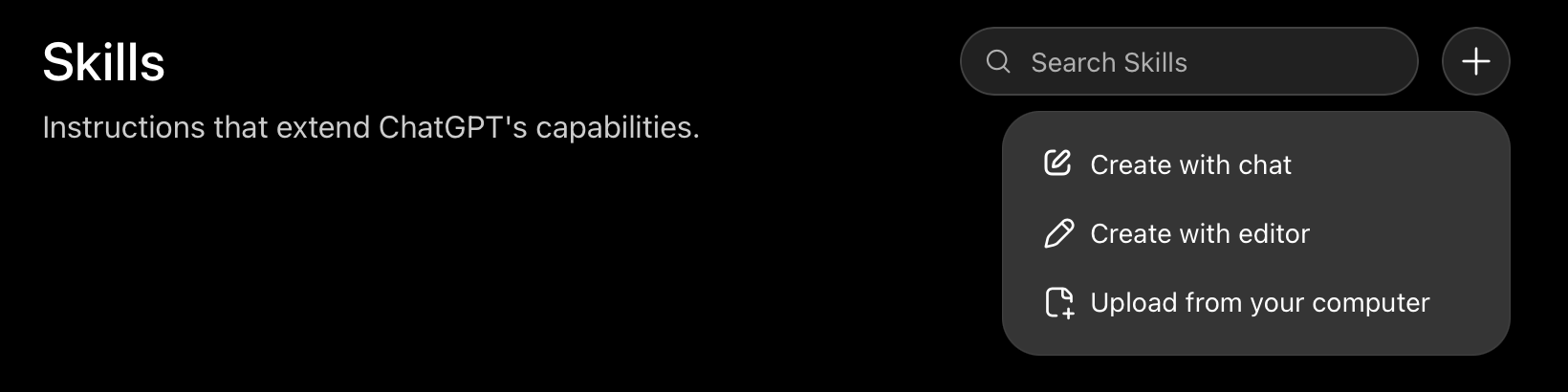
- Click Create, then Upload from your computer. In some interface versions, the + button opens this menu.
- Upload
skill.zipand finish adding the skill. - Open a new chat. If you see the Chat / Work switch, select Work. Type
@and choose the Playphrase.me skill from the list.
Try this as your first prompt:
@PlayPhrase.me How can I politely decline an invitation? Explain in simple English and give me links to hear the expressions on Playphrase.me.Do I need experience with Playphrase.me?
No. Start with a question in ChatGPT. The answer links to searches for specific expressions on the website, where you can listen to lines and move between available results.
Where does the video play?
On Playphrase.me. The explanation and conversation stay in ChatGPT. An answer doesn't mean ChatGPT has watched every scene or can hear a video open in another tab.
Can I choose the language of the explanations?
Yes. Describe your situation and request explanations in the language you prefer. The expressions you study and queries sent to the English corpus remain in English. You can specify another explanation language in the conversation.
Which languages can I learn?
This skill is designed primarily for English. Playphrase.me also has corpora in other languages. The language of this page, ChatGPT's explanations and the lines you search for are separate choices.
Do I have to do a lesson every time?
No. Ask a single question, compare two phrases or find a line. Lessons and exercises come when you want them and ask for them.
What happens if ChatGPT can't retrieve catalog data?
It may suggest wording with a regular search link. That wording isn't a confirmed Common Phrases entry. The examples on this page use expressions retrieved from the catalog.
What if a link doesn't have a suitable example?
Say so in the same chat. Try a shorter fragment or another way to express the idea. The corpus doesn't contain every possible phrase; a search link alone doesn't guarantee the scene you need.
What's included when I install the skill?
The archive contains instructions for ChatGPT. It doesn't change your ChatGPT plan or access to Playphrase.me features. The ability to add skills depends on your ChatGPT account and workspace settings.